A practical breakdown of what Shopify development actually costs—what sits behind small fixes, theme customization, custom builds, and monthly support, and which factors move a quote up or down.
Shopify development cost depends on scope, not page count. Small theme fixes and content edits usually land in the hundreds, focused customization work in the low thousands, and full redesigns or custom builds meaningfully higher, with ongoing support billed monthly. Price is driven by how much custom logic, data, and integration work sits behind the request—plus the condition of the theme you already have. A store with a clean theme and a clear spec costs far less to work on than one with years of layered app code and undocumented edits.
Almost every Shopify development conversation starts the same way: “what does this cost?” The honest answer is that Shopify development is priced by scope and risk, not by a menu. Two stores can request the same feature—say, a bundle builder on the product page—and get quotes that differ by an order of magnitude, because one store has a clean, current theme and the other has three years of app snippets welded into its layout file.
This guide breaks down what actually drives Shopify development pricing, what different tiers of work look like in practice, and how to prepare a request so the estimate you get back is accurate instead of padded. If you already know the work is a full rebuild, read the Shopify website redesign guide next. If the work is continuous rather than a project, the Shopify maintenance guide covers retainer models.
How Much Does Shopify Development Cost?
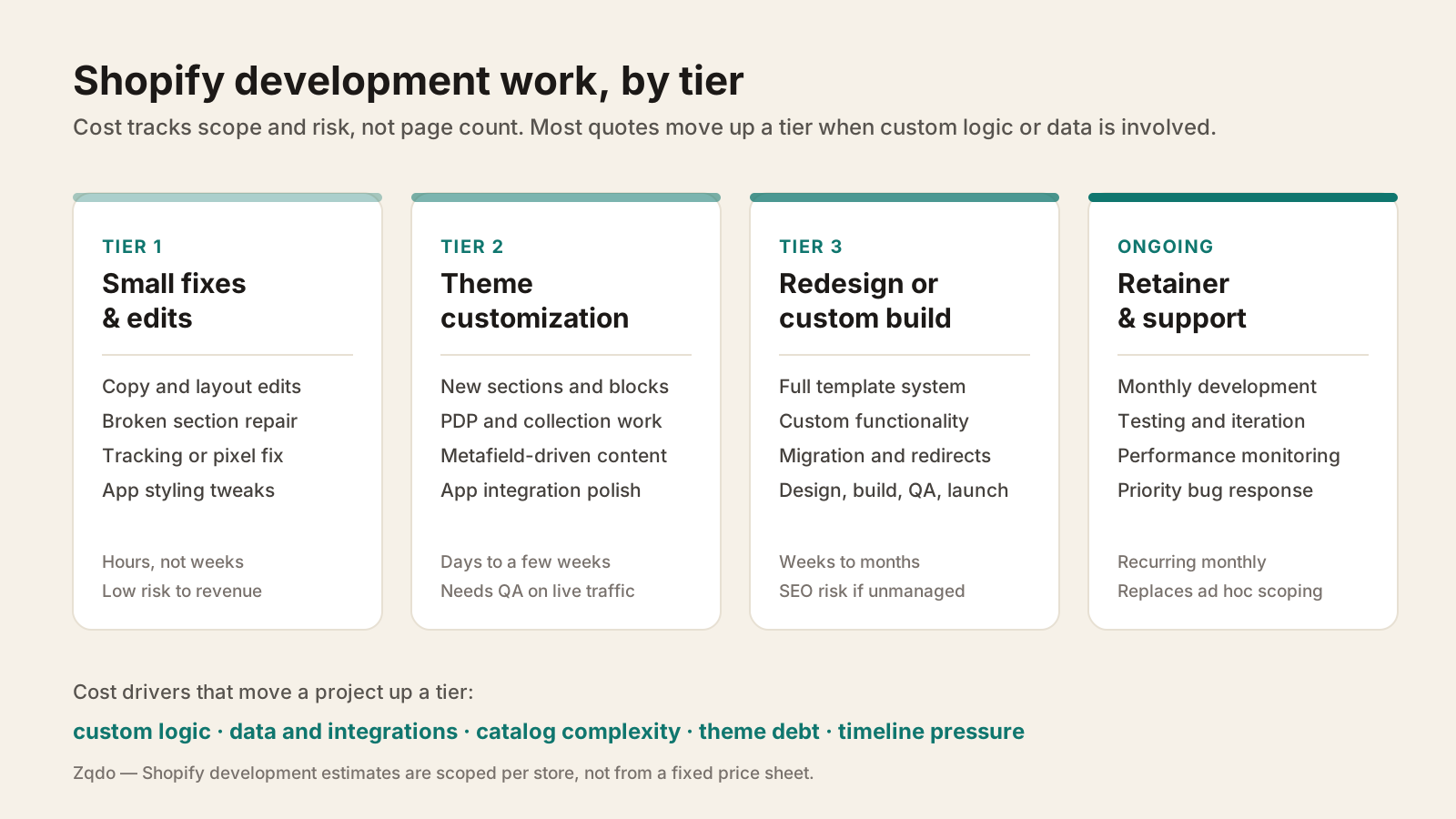
Shopify development typically falls into four tiers: small fixes and edits, theme customization, redesigns or custom builds, and ongoing monthly support. Across the market, small fixes are often priced in the hundreds, focused customization work in the low thousands, and full redesigns or custom functionality builds significantly higher. Retainers are billed monthly against a block of hours or a defined scope. Those are market ranges, not a Zqdo price list—every store gets scoped on its own condition.
Type of work
What it usually includes
Typical market range
Small fixes and edits
Content and layout edits, broken section repair, tracking or pixel fixes, app styling tweaks
Hundreds
Theme customization
New sections, PDP and collection changes, metafield-driven content, app integration polish
Low thousands
Custom functionality
Custom cart or checkout logic, B2B workflows, API work, complex merchandising rules
Mid to high thousands and up
Redesign or custom build
Full template system, information architecture, migration, redirects, QA, launch
Highest project tier
Ongoing support
Monthly development capacity, priority bug response, iteration and testing
Recurring monthly
Projects move up a tier for predictable reasons. A request stops being “theme customization” the moment it needs data that Shopify does not expose in the theme by default, needs to stay in sync with another system, or needs to behave differently for different customer segments. Those requirements add specification, edge cases, and QA—which is where hours accumulate.
Cost tracks scope and risk. Custom logic, integrations, and existing theme debt are what push a project into a higher tier.
What Determines Shopify Development Cost?
Cost is set by how much has to be designed, built, integrated, and verified—and by how much of your existing store has to be untangled first. Here is what changes an estimate most in real projects.
Theme type and current condition
A current Online Store 2.0 theme with sections, blocks, and metafield support is the cheapest starting point, because most requests become configuration and new sections rather than surgery. A heavily modified theme, a vintage theme, or one where several developers have layered edits over the years costs more for identical work—every change requires reading unfamiliar code and testing for side effects. Theme structure fundamentals are covered in the Shopify theme development guide.
Custom functionality and Liquid or JavaScript work
Anything that has to compute, conditionally render, or respond to shopper behavior costs more than static content. Custom Liquid logic, cart manipulation, dynamic pricing displays, variant-dependent behavior, and JavaScript-driven interactions all require both build time and a real QA pass across devices, variants, and edge cases like sold-out or preorder states.
Apps, integrations, and APIs
App work is rarely just installation. Subscription widgets, review platforms, and email tools ship with their own markup and styling that usually needs customization to feel native. Integrations with an ERP, a PIM, a 3PL, or a custom backend involve authentication, data mapping, error handling, and sync rules. See the Shopify apps hub for how app decisions ripple into development cost.
Shopify Flow and operational automation
Automation is often the cheapest high-value development you can buy, because it removes recurring manual work rather than adding surface area. But Flow builds still need scoping: triggers, conditions, tagging conventions, and failure handling. The Shopify Flow automations guide walks through what is realistic to automate.
Catalog size and complexity
A 40-product catalog and a 12,000-SKU catalog are different engineering problems. Large catalogs bring variant limits, filtering and faceting requirements, metafield architecture, bulk data operations, and performance considerations on collection templates. Complexity in the catalog shows up as complexity in templates, and templates are where development hours live.
Migration work
Migrating from WooCommerce, Magento, BigCommerce, or a headless setup adds data mapping, URL structure planning, redirect mapping, and content parity checks. Migration is usually the single biggest multiplier on a project budget, and it is also where skipping steps creates the most expensive cleanup.
Technical debt
Debt is the invisible line item. Duplicate scripts, dead app code from uninstalled apps, inline styles overriding the theme, and hardcoded content in templates all slow down every future change. Some projects need a cleanup phase before the requested feature can be built safely, and a good estimate will tell you that up front instead of absorbing it silently.
Design, QA, performance, and search requirements
Custom design costs more than adapting a theme's existing design system. Thorough QA—real devices, multiple variants, checkout, tracking verification—adds hours but prevents revenue incidents. Performance budgets and Core Web Vitals targets change how code gets written; so does keeping structured data, headings, and internal linking intact for SEO and AEO. These are not optional extras on a store that depends on organic traffic. See the Shopify performance hub for how speed work is scoped.
Timeline
Compressed timelines cost more. A four-week build squeezed into ten days means parallel work, more coordination, and less room for iteration. Launch-critical deadlines around Black Friday or a product drop reliably raise the price of the same scope.
Shopify Theme Customization vs. Custom Development
Theme customization means working within your theme's existing architecture—adding sections, restyling components, and configuring what Shopify already supports. Custom development means building behavior the platform or theme does not provide out of the box. Customization is cheaper and faster; custom development is what you pay for when the business requirement genuinely does not fit the standard toolkit.
Dimension
Theme customization
Custom development
Typical scope
Sections, styling, layout, content structure
New logic, integrations, custom workflows
Relative cost
Lower
Higher
Timeline
Days to weeks
Weeks to months
Risk profile
Contained to templates touched
Requires broader QA and monitoring
Best when
The theme mostly works and needs refinement
The business model needs behavior the theme cannot express
Maintenance load
Low, if built as proper sections
Ongoing—custom code needs an owner
A useful test: if you can describe the change in terms of what appears on the page, it is probably customization. If you have to describe rules—“only for wholesale customers,” “only when inventory is below five,” “only after the third order”—you are in custom development territory, and the estimate should reflect the specification work, not just the build.
How Much Does It Cost to Hire a Shopify Developer?
Hiring cost depends on the model you choose. Freelancers, agencies, and in-house hires price differently and carry different tradeoffs in availability, breadth, and continuity. None of them is universally right; the fit depends on how much work you have and how critical the store is to revenue.
Model
Strengths
Tradeoffs
Freelance developer
Lower overhead, direct communication, flexible for defined tasks
Availability varies, narrower skill coverage, single point of failure
Agency
Team coverage across design, development, and strategy; process and QA
Deep product context, immediate availability, long-term ownership
Salary plus benefits, hiring risk, single skill set to cover everything
Specialist consultant or retainer partner
Senior decision-making without a full-time hire; continuity between projects
Capacity is bounded; works best with clear priorities
Rates vary widely by region, seniority, and specialization. What matters more than the hourly number is throughput and rework: a higher rate that ships correct work the first time and does not break checkout is usually cheaper per outcome than a low rate that requires a second developer to fix. For many mid-sized brands, the practical answer is a hybrid—internal marketing and merchandising ownership, with development capacity retained externally.
What Does a Shopify Developer Actually Do?
A Shopify developer's job is broader than writing Liquid. On most engagements, the work spans the storefront, the apps attached to it, the data behind it, and the measurement that tells you whether any of it worked.
Theme architecture: sections, blocks, templates, and settings that let your team change the store without a developer for every edit.
Liquid, JavaScript, and CSS development for storefront behavior and layout.
Metafields and metaobjects to model product and content data properly instead of hardcoding it.
App evaluation, installation, customization, and conflict resolution.
API and integration work between Shopify and the systems that run the business.
Shopify Flow automations for operations, tagging, fulfillment holds, and internal alerts.
Performance work: script and app auditing, image handling, Core Web Vitals.
CRO implementation and A/B test builds so hypotheses can actually be shipped and measured.
Analytics and tracking accuracy across Shopify, GA4, and marketing platforms.
Technical SEO and AEO structure: headings, structured data, crawlable content, internal linking.
Ongoing maintenance, theme updates, and bug response.
How to Get an Accurate Shopify Development Estimate
Vague requests produce padded estimates, because the developer has to price the uncertainty. The more of the following you can supply, the tighter the number gets—and the fewer surprises appear mid-project.
Describe the outcome, not just the feature. “Reduce size-selection confusion on PDPs” gives more useful scope than “add a size chart popup.”
Share store access or a preview theme so the developer can read the actual code instead of guessing.
List every app that touches the affected templates, including ones you are not sure are still in use.
Name the theme, its version, and whether it has been customized.
Provide examples of the behavior you want, including edge cases—sold out, preorder, wholesale, subscription.
State your real deadline and what it is tied to, so timeline pressure can be priced honestly.
Say who owns content, design, and copy, and whether those assets exist yet.
Define how success will be measured, so QA and analytics are scoped in rather than bolted on.
Ask what is excluded from the estimate—that answer is often more revealing than what is included.
Is Shopify Development Worth the Investment?
Shopify development is worth it when a specific constraint is costing you money or time—and less worth it when the motivation is that the store “feels dated.” The value case is easiest to defend in a few situations, though results always depend on traffic, offer, and market conditions.
Conversion friction: measurable drop-off on product pages, cart, or checkout that traces to a fixable experience problem.
Performance: slow mobile load hurting both shopper patience and paid traffic efficiency.
Customer experience: confusing variants, unclear shipping expectations, or broken flows that generate support tickets.
Operations: manual work that automation can absorb, freeing hours every week.
Technical debt: an accumulation that makes every future change slower and riskier than it needs to be.
Growth constraints: a store that cannot support B2B, subscriptions, or a larger catalog without structural work.
No credible developer can promise a specific return. What a good scope can do is tie the work to a measurable baseline before you start—conversion by template, mobile load time, support ticket volume, hours spent on manual tasks—so you can judge the outcome instead of arguing about it. The Shopify CRO hub covers how to set those baselines for conversion work.
Shopify Development Examples
The clearest way to understand cost is to look at what different types of requests actually involve. These are real Zqdo projects, spanning quick targeted work to ongoing web leadership—some as direct clients, some as contracted development support for agencies.
CH Premier — contracted Shopify development support for Minion Made across retention integrations, performance, and UX.
More examples across catalog size, integration depth, and engagement model are collected on the work page.
Key Takeaways
✓Shopify development is priced by scope and risk, not by the number of pages or a fixed menu.
✓Small fixes typically sit in the hundreds, focused customization in the low thousands, and redesigns or custom builds meaningfully higher—market ranges, not fixed quotes.
✓Custom logic, integrations, catalog complexity, migrations, and existing theme debt are the biggest cost multipliers.
✓Theme customization is cheaper and faster; custom development is justified when the business rule genuinely does not fit the platform's defaults.
✓Freelance, agency, in-house, and retainer models trade cost against availability, breadth, and continuity.
✓Accurate estimates require store access, an app inventory, real edge cases, and a stated deadline.
✓Judge the investment against a measured baseline—no one can honestly promise a specific return.
Frequently Asked Questions
How much does Shopify development cost?+
It depends on scope. Across the market, small theme fixes and content edits often land in the hundreds, focused customization work in the low thousands, and full redesigns or custom functionality builds significantly higher. Ongoing support is usually billed monthly. The main cost drivers are custom logic, integrations, catalog complexity, and the condition of your existing theme.
How much does it cost to hire a Shopify developer?+
Rates vary by region, seniority, and specialization, and by whether you hire a freelancer, an agency, an in-house developer, or a retained specialist. Compare throughput and rework rather than hourly rate alone—work that ships correctly the first time is usually cheaper per outcome.
Why do Shopify development quotes vary so much?+
Because quotes are rarely scoped the same way. One may include discovery, QA across devices, analytics verification, and post-launch support while another covers only the build. Store condition matters too: identical requests cost more on a heavily modified theme with layered app code.
Is theme customization cheaper than custom development?+
Usually, yes. Customization works within the theme's existing architecture—sections, blocks, styling, and content structure. Custom development adds behavior the platform or theme does not provide, which requires specification, edge-case handling, and broader QA.
How long does Shopify development take?+
Small fixes can be same-week. Theme customization typically runs days to a few weeks. Redesigns, migrations, and custom functionality builds usually run weeks to months depending on catalog size, integrations, and how much content and design work has to happen in parallel.
Do I need a Shopify developer or can I use apps?+
Apps are the right answer when a well-supported app matches your requirement closely. Development becomes the better option when you would need several overlapping apps, when app subscriptions exceed the cost of building once, or when the apps hurt performance or cannot express your business rules.
How can I reduce Shopify development costs?+
Give a clear written scope with real edge cases, provide store access up front, keep the theme current, remove unused apps and dead code, batch related requests into a single release instead of many small ones, and avoid compressed deadlines when you can. Ongoing support arrangements also tend to cost less per change than repeated one-off scoping.
Continue Learning
Related guides, real Zqdo project examples, and the category hub for deeper exploration.
David Frempong is the founder and digital consultant at Zqdo. He is a hands-on web developer and Shopify developer who helps ecommerce brands and local businesses improve their websites, integrations, SEO, AEO, analytics, and conversion performance.